

The ground remembers its power in the Philippines. Just over a week after twin typhoons battered the islands, the earth itself trembled violently late Tuesday. A 6.9 magnitude earthquake has left at least 69 people dead, dozens injured, and a central province reeling, forced to declare a state of calamity.
For the thousands who spent the night on the streets, the terror was far from over. The main quake was followed by a relentless series of aftershocks, each one a fresh wave of fear.
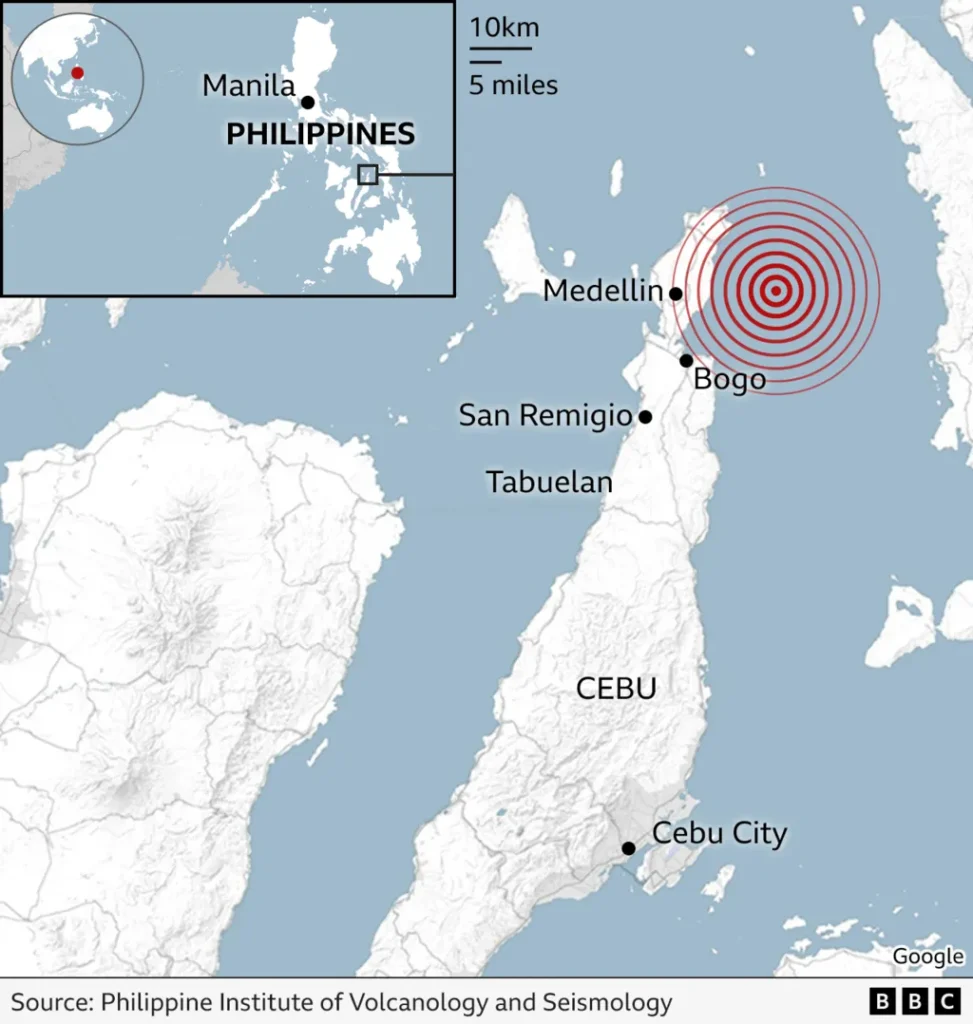
The Epicenter of Grief: Bogo Bears the Brunt
The small town of Bogo, located near the earthquake’s epicenter in the Visayas region, suffered the most devastating losses. Heartbreaking images emerging from the town show body bags lining the streets and makeshift tent hospitals struggling to treat hundreds of injured.
The tragedy hits with a cruel sense of irony. Seven of the victims lived in a village originally built to house survivors of Typhoon Haiyan, a storm that claimed over 6,000 lives 12 years ago. The very ground meant to be a refuge has now become a site of new sorrow.
On the Ground: A Night of Trauma and Darkness
The immediate aftermath was one of chaos and fear. One Cebu resident shared his experience with the BBC, describing a night without power or water, surrounded by the sounds of crying, traumatized children. The voices in the dark painted a picture of a community pushed to its limit.
The quake’s reach was unpredictable. In the municipality of San Remigio, it interrupted a basketball game—a common, joyful community event. Almost 20 people from that game were sent to the hospital, with at least one casualty reported.
The Challenge for Rescuers: Broken Land, Broken Lines
The path to help is littered with obstacles. Buckled roads, cracked highways, and fallen bridges are making it incredibly difficult for emergency services to reach the most affected areas. With power lines down across the region, communication is a major challenge, isolating communities and slowing the flow of critical information.
National police and fire crews are now in a race against time, prioritizing search and rescue operations while working to restore electricity and deliver essential relief supplies.
A History Written in Stone, Now Cracked
The Philippines’ rich history adds another layer of concern to the disaster. Cebu, one of the first islands colonized by Spain in the 1500s, is home to many ancient, historically significant churches.
The Archbishop of Cebu has wisely urged devotees to stay away from these structures until they can be fully assessed for damage. Earlier footage captured the terrifying moment an old Catholic church tower swayed and partially collapsed—a stark symbol of the quake’s destructive force.
Why the Philippines? The Unforgiving “Ring of Fire”
For those wondering why the Philippines is so frequently in the path of natural disasters, the answer lies deep beneath the surface. The archipelago nation sits directly on the Pacific “Ring of Fire,” a horseshoe-shaped belt around the Pacific Ocean known for its constant tectonic activity.
Here, the Earth’s plates grind against each other, creating a perfect storm of earthquakes and volcanoes. Combined with the annual path of Pacific typhoons, it makes the Philippines one of the most disaster-prone countries in the world.
As the national disaster agency continues its rigorous checks, the death toll may still rise. For the people of Cebu and the central Philippines, the shaking may have stopped, but the long, hard road to recovery has just begun.
Our thoughts are with all those affected by this tragedy.